FOR IMMEDIATE RELEASE
Contact: Amy Bonderoff, Director, Development & Communications, VOLS
abonderoff@volsprobono.org, 212-966-4400
VOLUNTEERS OF LEGAL SERVICE (VOLS) ANNOUNCES ITS 2026 PRO BONO DEAN’S LIST
NEW YORK, NY – October 1, 2026
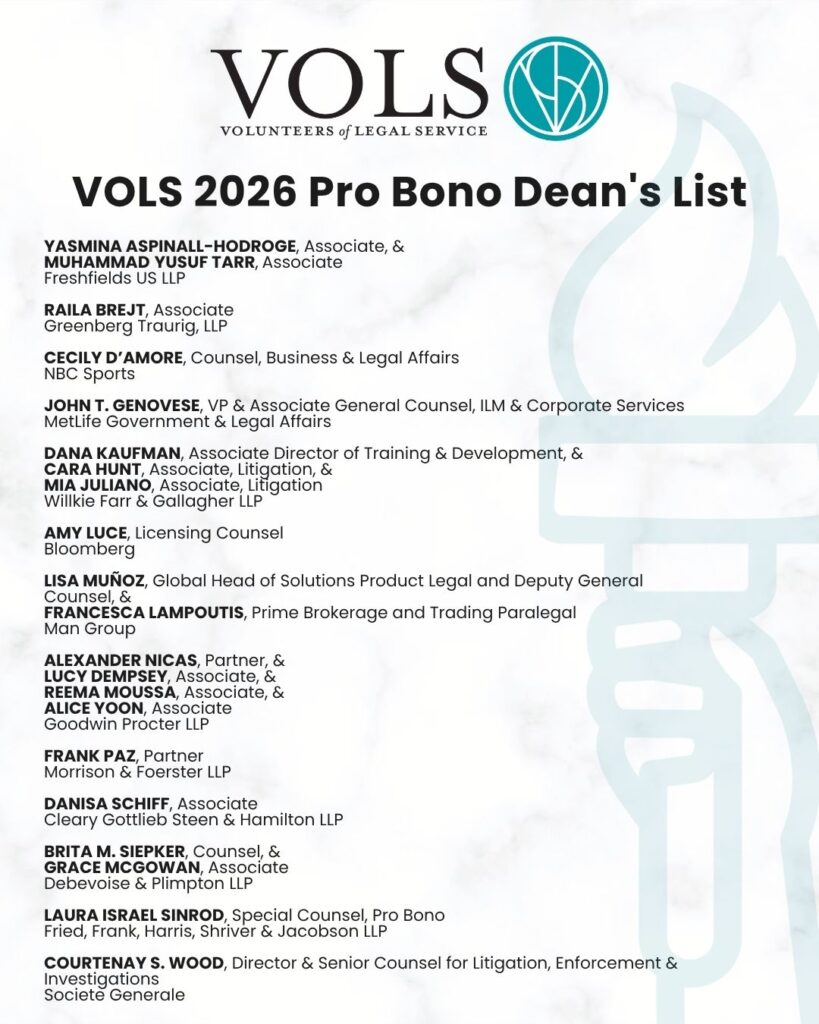
Volunteers of Legal Service (VOLS) is proud to announce the VOLS 2026 Pro Bono Dean’s List, recognizing 21 exceptional and committed individuals who have made a tremendous impact in helping New Yorkers access justice. Our Dean’s List awardees come from law firms and companies throughout New York City and have worked across VOLS’ legal services projects. To recognize and celebrate the VOLS 2026 Pro Bono Dean’s List, VOLS will share information about our awardees throughout October, National Pro Bono Month.
The VOLS Dean’s List is dedicated to the memory of William J. Dean, VOLS’ former executive director of 25 years, who served as a pro bono advocate and champion throughout his career. In 1984, the VOLS Pro Bono Pledge, the first of its kind, sent a message. It has been understood since that pro bono work is the duty of every law firm and lawyer in New York City and that it should be valued as highly as paid work. As it was then, pro bono remains at the heart of VOLS’ mission.
Congratulations and thank you to the VOLS 2026 Pro Bono Dean’s List Awardees!
Dean’s List Awardee Features:
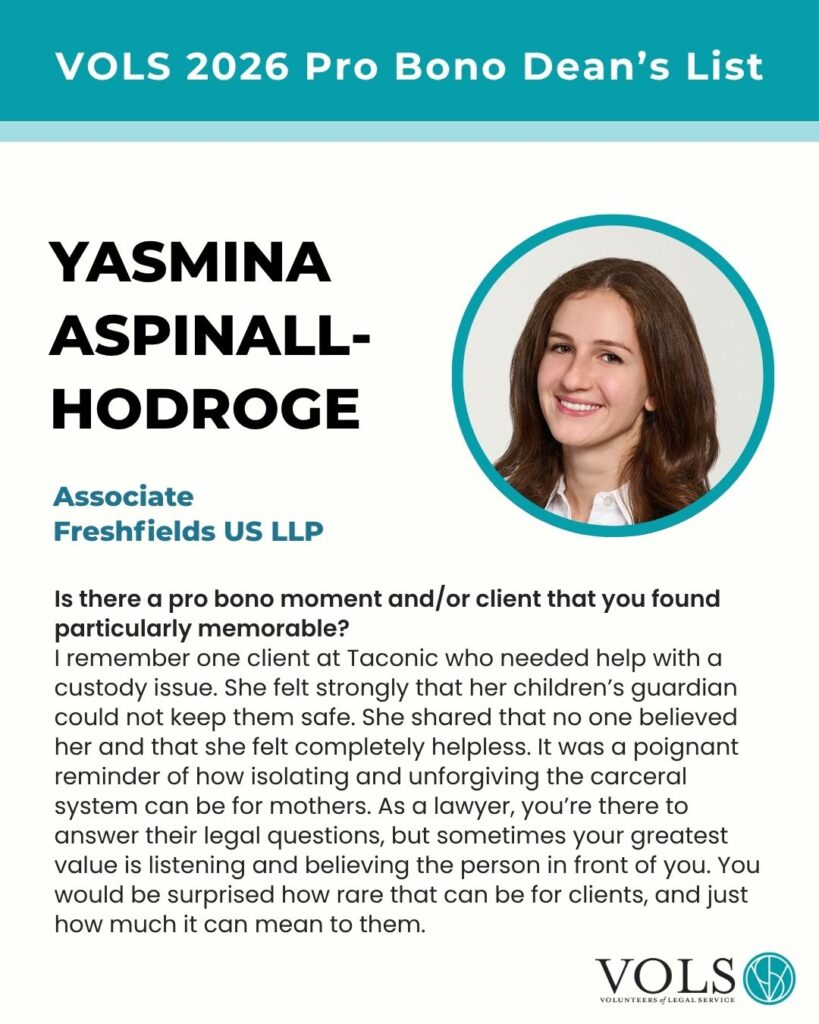
YASMINA ASPINALL-HODROGE
Associate
Freshfields US LLP
How did you become involved with VOLS? What interested you in volunteering with this specific project? I first became involved with VOLS through the Incarcerated Mothers Law Project (IMLP). During law school, I developed an interest in both family law and prison law. My prison law classes taught me about the prison-industrial complex, but also, at a more human level, how incarcerated individuals often have limited access to justice despite being among those who need it most. Family law was another one of my favorite classes. Few areas of the law reach so directly into the most intimate and personal aspects of our lives. IMLP struck me as the perfect opportunity to bring those two interests together and put them to use.
How has pro bono work impacted your experience as an attorney? Pro bono work has broadened both my skill set and my sense of what it means to be a lawyer. My day-to-day practice is mainly international arbitration, where matters can take years of preparation and even longer before that work translates into concrete results for a client. The IMLP clinics are the opposite. You meet clients directly and give advice in real time. I quickly learned just how much good can be done in the span of a single day-clinic. Pro bono work has also made me a better listener. Trauma-informed lawyering requires patience, attentiveness, and adaptability—skills that have made me a better attorney across all my matters. And the work is deeply meaningful. When you interface directly with clients and build trust over time, it reinvigorates your role as not only an attorney but a true advocate.
Is there a pro bono moment and/or client that you found particularly memorable? I remember one client at Taconic who needed help with a custody issue. She felt strongly that her children’s guardian could not keep them safe. She shared that no one believed her, and that she felt completely helpless. It was a poignant reminder of how isolating and unforgiving the carceral system can be for mothers. As a lawyer, you’re there to answer their legal questions, but sometimes your greatest value is listening and believing the person in front of you. You would be surprised how rare that can be for clients, and just how much it can mean to them.
Tell us about how you have worked with the VOLS’ legal team. I’ve worked with Stephanie Taylor and Olivia Pickard during just about every IMLP clinic visit. They are incredibly knowledgeable and kind. They also ensure that the clinics run smoothly despite all the logistical hurdles thrown their way. Their support takes many forms: reviewing files, hopping on a call to talk through next steps, and offering advice during clinics. Their continued guidance evidences their deep understanding of the law, attentiveness to the needs of their clients, and trauma-informed emotional intelligence. I’ve learned a lot from Steph and Liv.
What advice do you have for colleagues who are on the fence about volunteering? You have to try it at least once! Not only is the work fulfilling, but you also learn a lot from the VOLS legal team, fellow volunteers, and the individuals you’re helping. It’s an eye-opening experience that leaves volunteers moved and wanting to return. The IMLP clinics can sound daunting, but the VOLS team handles the logistics so seamlessly that participants can concentrate on delivering quality legal assistance.
MUHAMMAD YUSUF TARR
Associate
Freshfields US LLP
How did you become involved with VOLS? What interested you in volunteering with this specific project? I got involved with VOLS in the Fall of 2024, when I first began working at Freshfields. From courses I took during my undergraduate experience, I was first introduced to the Prison-Industrial complex. Reading the story and works of Angela Davis as well as watching the documentary “13th” by Ava DuVernay on Netflix first opened my eyes to the effects of mass incarceration and the ways society at large can overlook incarcerated individuals. When I saw the listing on our Pro Bono weekly newsletter, I knew that providing relief for the women we work with could go a long way and allow me to actualize this kind of meaningful work.
How has pro bono work impacted your experience as an attorney? I have found the work to really upend my day-to-day understanding of lawyering. Where order and efficiency are the golden standard in our industry, visiting a prison on our VOLS trips or even trying to connect to a phone operator for a client call, disproves that lawyering is anything but predictable. Walid Daqqa, a well-known Palestinian prisoner, wrote a piece called On Parallel Time, detailing how time warps in prison and for those who are incarcerated. Working with VOLS has shown me that at the end of the day, we are not the masters of time, but even as our clients are impacted by measures beyond their control, that inputting the best of our time and our efforts can be the most powerful way we can serve our clients.
Is there a pro bono moment and/or client that you found particularly memorable?
My colleagues, Eunice Ju and Yasmina Aspinall-Hodroge, and I added a few summer associates to one of our matters and invited them to listen in our client call. This was our first ever contact with the client, who was experiencing a family dispute caused by a void in guardianship for her young children after her mother’s untimely passing. Despite the intention of the call being an onboarding opportunity, the experience was tender and human. Although the client mourned her loss, as the call progressed, she expressed trust in us and even excitement, all because we had chosen to spend some time to listen to her. Out of all the VOLS clients, I think about her the most, and how grateful I am that she entrusted us with her story.
Tell us about how you have worked with the VOLS’ legal team. I have worked with Steph and Liv by attending clinics at Taconic and, most recently, at Rosie’s. I have progressed from co-working on cases with one other volunteer to handling my own cases and working with other VOLS-affiliated attorneys like Cecily D’amore. Steph and Liv have been incredible—always willing to hop on calls with me and the Freshfields teams, reviewing our filings, and uplifting us with their bright attitudes and vast knowledge on family law.
What advice do you have for colleagues who are on the fence about volunteering? Hop over the fence! Lawyering is about risk-taking and developing our knowledge of the law, even if it isn’t our day-to-day specialties. Leaving the office and stepping into the edifice of prison is an eye-opening experience, and the breadth of knowledge and support we receive as we assist our clients truly makes for a vast safety net in providing this very needed assistance.
RAILA BREJT
Associate
Greenberg Traurig, LLP
How did you become involved with VOLS? What interested you in volunteering with this specific project?
When I learned about the VOLS Senior Law Project, I was immediately intrigued because I’ve always been interested in trust and wills work. Volunteering through the project allows me to channel that interest into meaningful pro bono service, helping seniors with their estate planning needs.
How has pro bono work impacted your experience as an attorney?
It provides the opportunity to engage directly with the community and connect with individuals on a personal level. Pro bono work offers a meaningful complement to my practice by allowing me to broaden my skills and perspective.
Is there a pro bono moment and/or client that you found particularly memorable?
During my first client’s will execution ceremony, the client’s daughter pulled me aside afterward to thank me for making the process so smooth. She shared that while working through the life planning topics together, I had kept things so conversational that she hadn’t realized how emotionally heavy the subject matter was until the will execution ceremony brought those feelings to the surface.
Tell us about how you have worked with the VOLS’ legal team.
The VOLS legal team has served as educators and mentors. Their support has been invaluable, whether helping me navigate complex estate planning questions or providing guidance during difficult situations.
What advice do you have for colleagues who are on the fence about volunteering?
I would strongly encourage anyone to get involved. Pro bono work allows you to give back to the community and makes you a more well-rounded attorney by exposing you to new areas of law and deepening your connection to the people you serve.
CECILY D’AMORE
Counsel, Business & Legal Affairs
NBC Sports
How did you become involved with VOLS? What interested you in volunteering with this specific project?
I became involved with VOLS toward the end of my first year as an M&A/PE associate at Fried Frank, when the VOLS Incarcerated Mothers Law Project was brought on at the firm. I had some prior exposure to family law, including through a college internship at a family law firm, and, while in law school, volunteer work on uncontested divorces through Sanctuary for Families and exposure to child support, custody/visitation, and paternity matters as a Pro Bono Scholar at Family Legal Care, so I knew the Incarcerated Mothers Law Project would be a good fit for me. I was very lucky that the VOLS team, and NBCUniversal, allowed me to continue this work and bring others at NBCUniversal into the fold, and I am thrilled that I still get to attend clinics with the folks at Fried Frank!
How has pro bono work impacted your experience as an attorney?
Pro bono work has been a fundamental part of my experience as an attorney, and I am, without a doubt, a better attorney because of it. Pro bono work has taught me so much about direct client service, refined my drafting skills, challenged the way I think about legal issues, and reinforced the power of simply listening and offering support, legal or otherwise. I am often reminded by my pro bono work that our legal system is not without its flaws, particularly when it comes to incarceration, so I see pro bono as a personal moral and ethical obligation of all attorneys, and, frankly, the least we can do with the skills and knowledge we’ve had the privilege of developing.
Is there a pro bono moment and/or client that you found particularly memorable?
There are countless clients from my years working on the Incarcerated Mothers Law Project that stick with me, but one story that I love to share is the uncontested divorce we were able to get for a client who had been incarcerated for over 15 years by the time we met her. She hadn’t seen or spoken to her husband since before her incarceration, and was eager to get a divorce that was, evidently, long overdue. I will never forget her pure joy and sense of relief when, after months (or for her, years) of waiting, we handed her the judgment of divorce. I’ve had the privilege of seeing her at clinics since then, where she reminded me of her appreciation for our help and told me that she was finishing up getting her bachelor’s degree. The responses of gratitude from clients and being able to see them move forward with at least one weight lifted in their lives, constantly reminds me of the importance of this work.
Tell us about how you have worked with the VOLS’ legal team.
I cannot overstate how lucky we are to work on the Incarcerated Mothers Law Project with Stephanie Taylor and Liv Pickard, our fearless VOLS leaders, at the helm. Not only are they a wealth of expertise and knowledge, but they make sure that every volunteer feels supported at the clinic and on any follow-up work. They empower volunteers to take the lead in client meetings. They provide live insight in a way that allows volunteers to confidently convey legal analysis to clients, even if the volunteers are unfamiliar with the issue, all while running the clinic in the background. Working within the inconsistent and ever-changing parameters of correctional facilities in New York to run legal clinics is no small feat, and Steph and Liv somehow make it look easy.
What advice do you have for colleagues who are on the fence about volunteering?
Take the leap! So much of being an attorney is having something new thrown at you and diving in head first with the confidence that you have the skills to figure it out. I had never been inside a correctional facility before participating with the Incarcerated Mothers Law Project and was intimidated by that, but VOLS provided comprehensive onboarding and supported me through the volunteer experience start-to-finish. I often think back to my first visit, when we addressed the legal issue in a matter of a few minutes, and I then spent about half an hour just getting to know the client and listening to her story. It’s very fulfilling to look back now at the many clients I’ve helped, lessons I’ve learned, and expertise I’ve developed along the way. Take that first step!
ALEXANDER NICAS
Partner
Goodwin Procter LLP
How did you become involved with VOLS? What interested you in volunteering with this specific project?
I became involved with VOLS through Rebecca Broches from Goodwin’s Pro Bono team, who approached me about acting as the partner supervisor for the Goodwin teams working closely with VOLS on the Housing Benefits Court Initiative. I happily accepted as I had fond memories of spending a summer during law school interning for Judge Eleanora Ofshtein when Judge Ofshtein was a judge in the Housing Part in Brooklyn.
How has pro bono work impacted your experience as an attorney?
Pro bono work is an important part of my practice. It is incredibly meaningful to give back to the community and to help those in need. I have participated in several pro bono initiatives over the years, and the Housing Benefit Court Initiative has been particularly meaningful. I’ve really enjoyed helping tenants obtain benefits that allow them to maintain their housing (and avoid homelessness in many cases). For many, the assistance we’re providing has truly been lifechanging.
Is there a pro bono moment and/or client that you found particularly memorable?
Every tenant that we’ve successfully helped receive benefits is memorable. I’m hopeful that I can help spur many more positive outcomes over the coming months!
Tell us about how you have worked with the VOLS’ legal team.
Jean Stevens from VOLS has been our guiding light since we became involved in the Housing Benefits Court Initiative. Jean has been accessible to our associates for even the simplest of questions and issues and has helped us navigate the bureaucracy of HRA and other city agencies. We couldn’t have done half of what we’ve done without Jean!
What advice do you have for colleagues who are on the fence about volunteering?
Move outside of your comfort zone, you won’t regret it!
LUCY DEMPSEY
Associate
Goodwin Procter LLP
How did you become involved with VOLS? What interested you in volunteering with this specific project?
When I heard about the VOLS Housing Court Benefits Initiative I immediately signed up as I was interested in helping fellow New Yorkers who are facing eviction or need help applying for government housing benefits.
How has pro bono work impacted your experience as an attorney?
Pro bono continuously pushes me to work outside my comfort zone and in new areas of law. I enjoy using my legal training to make an impact on individuals and seeing tangible results from my efforts.
Is there a pro bono moment and/or client that you found particularly memorable?
I recently helped an 84-year-old man in a stressful post-eviction scenario. Working with the fantastic VOLS legal team, we were able to secure a one-shot deal for him to back-pay all of his outstanding rent and compel the landlord in court to let the tenant back into his apartment. He was a vulnerable client who had been making a good faith effort to pay his rent but was facing difficultly navigating bureaucratic and technological systems and needed our assistance to avoid ending up in a shelter.
Tell us about how you have worked with the VOLS’ legal team.
Working with Jean Stevens at the Benefits Initiative has been a pleasure and we have worked together closely this year. I’ve learned so much about tenant law, housing court and the ins and outs of the New York housing agency from her. It’s been incredibly reassuring to have her guidance and to speak with her whenever I needed advice on the next step for my client.
What advice do you have for colleagues who are on the fence about volunteering?
VOLS is a great place to start because you will have a wealth of materials, training and experienced attorneys ready to help guide you!
REEMA MOUSSA
Associate
Goodwin Procter LLP
How did you become involved with VOLS? What interested you in volunteering with this specific project?
I became involved with Volunteers of Legal Service (VOLS) through Goodwin’s partnership with the VOLS Benefits Law Project and, in particular, the Housing Court Benefits Initiative. The project immediately stood out to me because it addresses a critical gap in access to information and pathways to avoiding eviction for New Yorkers facing housing insecurity. I was drawn to the opportunity to provide practical, direct assistance that could have an immediate impact on someone’s stability and well-being
How has pro bono work impacted your experience as an attorney?
Pro bono work has been one of the most rewarding aspects of my legal career thus far. It has allowed me to work directly with individuals facing significant challenges and to see firsthand how a guide in navigating the law can make a meaningful difference in the lives of individuals who can benefit from demystification of the law. My pro bono experience has strengthened my client counseling skills, has taught me to how to clearly communicate complex concepts, and has reminded me that the practice of law is ultimately about helping people solve problems.
Is there a pro bono moment and/or client that you found particularly memorable?
One particularly salient aspect of this work has been helping tenants navigate systems that can feel overwhelming and inaccessible. In several matters, the legal issues themselves were only part of the challenge. HCBI clients are often balancing housing concerns, financial pressures, and administrative hurdles at the same time. Seeing a client gain clarity about their options, access available benefits, or feel more confident advocating for themselves has been incredibly meaningful. Those moments reinforce how much impact even a limited-scope legal engagement can have.
Tell us about how you have worked with the VOLS legal team.
The VOLS legal team has been an outstanding partner throughout this work. They provide substantive training, guidance, and ongoing support throughout a given engagement. I’ve worked closely with VOLS attorneys and staff to conduct client intake, develop service plans, evaluate benefit eligibility, and troubleshoot issues that arise during our matters. The collaboration has been highly practical and mission-driven, and I have been consistently impressed by the team’s commitment to both their clients and the volunteer attorneys they support.
What advice do you have for colleagues who are on the fence about volunteering?
I would encourage anyone who is considering volunteering to give it a try. Many attorneys hesitate because they worry they lack subject matter expertise or enough time, but organizations like VOLS provide excellent training, resources, and mentorship. You are never expected to navigate the work alone. Pro bono matters can often fit alongside a busy practice, and the professional and personal rewards are significant. You develop new skills, build relationships, and most importantly, have the opportunity to make a tangible difference in someone’s life. For me, the experience has been both humbling and energizing, and I would recommend it to any colleague looking to get involved.
ALICE YOON
Associate
Goodwin Procter LLP
How did you become involved with VOLS? What interested you in volunteering with this specific project?
I became involved with VOLS when Goodwin launched a new pro bono project with the organization. I care deeply about housing justice issues and previously worked in a housing justice clinic during law school, so the opportunity felt like a natural fit. I was especially interested in helping tenants navigate difficult circumstances and to help them protect their housing.
How has pro bono work impacted your experience as an attorney?
Pro bono work has helped me become a more empathetic and thoughtful attorney. It has strengthened my counseling skills and taught me the importance of listening carefully, understanding a client’s individual circumstances, and explaining complex legal issues in a clear and compassionate way.
Is there a pro bono moment or client that you found particularly memorable?
One particularly memorable experience involved helping a tenant secure a one-shot deal with the HRA. Seeing how focused legal assistance could help remove barriers and bring a client closer to a meaningful resolution reinforced why this work is so important.
Tell us about how you have worked with the VOLS legal team.
I worked closely with and relied upon guidance from Jean Stevens at VOLS to move the client’s HRA application forward. Jean provided invaluable guidance throughout the process, and her knowledge and responsiveness helped us navigate issues throughout the process efficiently and helped us provide the best advocacy possible for the client.
What advice do you have for colleagues who are on the fence about volunteering?
I would encourage them to take the opportunity. Pro bono work is a valuable learning experience that allows attorneys, especially junior attorneys like me, to strengthen their client-counseling skills while making a real difference in the lives of individuals facing eviction. The work is both professionally enriching and personally meaningful.
AMY LUCE
Licensing Counsel
Bloomberg
How did you become involved with VOLS? What interested you in volunteering with this specific project? Immigration work has always been particularly meaningful to me and was one of the reasons I went to law school. I believe strongly in helping people understand and exercise their rights and, where I can, helping make a complex legal system more accessible.
I handled several pro bono immigration matters early in my career and was excited to get involved again through a volunteer clinic with the VOLS Immigration Project earlier this year. I signed up to assist with client intake, where I met Keighly from VOLS and an attorney from Debevoise. From there, we took on a Special Immigrant Juvenile case together.
How has pro bono work impacted your experience as an attorney?
Pro bono work is a big part of why I love being an attorney. I enjoy my day-to-day licensing practice, but pro bono offers something different: the chance to help someone navigate a legal system they may not otherwise have been able to access. You get to accompany someone through that process, provide both legal and human support, and hopefully help them exercise greater agency along the way. It is a powerful reminder of the impact legal training can have on someone’s life.
Is there a pro bono moment and/or client that you found particularly memorable?
One of my most memorable pro bono experiences began in law school. Through my school’s immigration clinic, my clinic partner and I represented a client seeking asylum and prepared and filed her application. About two years after I graduated, a message came through our otherwise dormant clinic group chat letting us know that the judge had granted her asylum. Knowing that I had been fortunate enough to contribute in some way to that outcome is something I’ll never forget.
More broadly, being trusted with clients’ stories is what stays with me. Immigration matters can involve incredibly difficult conversations, but there are also many moments when you get to laugh and smile together. I am continually inspired by the resilience and optimism of the people I’ve had the privilege to represent.
Tell us about how you have worked with the VOLS’ legal team.
I’ve worked with Keighly through both the VOLS Immigration Project clinic and a Special Immigrant Juvenile case. She has guided us through the case, reviewed drafts, and patiently answered my many, many questions. Taking on a matter outside your regular practice area can be daunting, but VOLS provides the support and resources that allow volunteer attorneys to do so with confidence. Keighly has been an incredible resource and is a wealth of knowledge.
What advice do you have for colleagues who are on the fence about volunteering?
Just try it! If there is an area of law or a cause that interests you, a clinic can be a great place to start without immediately committing to a full case or long-term matter. If you enjoy it, you can always become more involved from there.
And don’t be deterred if it falls outside your regular practice area. I’m a transactional attorney, and much of my pro bono experience has been in immigration. Beyond giving back, pro bono is an incredible way to challenge yourself as a lawyer and develop skills outside your day-to-day practice.
BRITA M. SIEPKER
Counsel
Debevoise & Plimpton LLP
How did you become involved with VOLS? What interested you in volunteering with this specific project?
I became involved with VOLS through Debevoise’s participation in a DACA program several years ago. I was drawn to the VOLS immigration project because it offered an opportunity to use my legal and language skills in a way that could have a meaningful impact on a person’s life. I was particularly interested in the DACA and SIJS programs, because it can change a young person’s life dramatically.
How has pro bono work impacted your experience as an attorney?
Pro bono work has been one of the most rewarding parts of my professional career. At its core, practicing law is about helping people work within legal confines to achieve their goals, and pro bono work exemplifies that in very tangible ways. Pro bono matters have also challenged me to work in arenas far from my corporate practice, including immigration court and family court, and have made me a more well-rounded attorney. I truly appreciate that Debevoise fully supports our participation in pro bono work.
Is there a pro bono moment and/or client that you found particularly memorable?
I am repeatedly humbled by the trust our pro bono clients place in us, often across a language barrier, a cultural gap and difficult lived experiences. They share with us their most personal stories and trust that we will hold the information in confidence and use it for their benefit. When years later approvals arrive, and they throw their arms around us, that stays with you.
Tell us about how you have worked with the VOLS legal team. The VOLS legal team has been an invaluable partner throughout the process. They have provided thoughtful guidance and expertise while also giving us the opportunity to take ownership of the legal work and client relationship. Working with VOLS has made it possible to contribute meaningfully while knowing that I have a knowledgeable team to turn to when questions arise.
What advice do you have for colleagues who are on the fence about volunteering? Pro bono work is a vital part of our professional responsibility. It may seem hard to fit pro bono work into your busy billable workload, or it may feel outside your comfort zone, but, with the support of an organization like VOLS, it is very feasible. Team up with someone at your firm with a different skill set, lean into the resources offered by partner organizations, and make a lasting difference in someone’s life who otherwise would not have access to legal representation.
GRACE MCGOWAN
Associate
Debevoise & Plimpton LLP
How did you become involved with VOLS? What interested you in volunteering with this specific project?
I initially connected with VOLS through a training session held by the Immigration Project. After the training, I signed up for the IP’s weekly immigration policy briefings, which have been an incredible resource for pro bono practitioners to stay up to date on the ever-changing landscape of immigration law. This spring, I signed up for an immigration screening clinic held by the IP with Debevoise and Bloomberg. At the clinic, another attorney and I spoke to Keighly at the IP about full-scope representation opportunities. Keighly then connected us with our SIJS client. I have worked on a few immigration pro bono matters but had not worked on a SIJS case before. I was interested in learning something new and connecting with a young person on their immigration case.
How has pro bono work impacted your experience as an attorney?
As a corporate attorney, I do not draft briefs, file motions, or interact with the courts in my day-to-day practice. My pro bono matters have provided me with opportunities to learn these skills and more. I also value the opportunity to work with clients one-on-one and use what little knowledge I have to help them navigate the immigration system. I have also been challenged to manage more responsibilities and take on more of a leadership role than I typically would as a junior attorney.
Is there a pro bono moment and/or client that you found particularly memorable?
Our SIJS client shared his graduation photo with us this summer. It was great to celebrate this accomplishment in his personal life, and I felt honored that he wanted to share this with us. Also, when the family court approved our client’s guardianship petition, I was able to tell him the good news over the phone. It’s special to share these wins, especially as positive moments become more infrequent in the world of immigration law.
Tell us about how you have worked with the VOLS’ legal team. We worked with Keighly at the IP on our SIJS case. She has been a wonderful advisor and mentor throughout our work together. Keighly equipped us with the knowledge and resources we needed to understand the complicated SIJS process and always made time in her busy schedule to answer questions and review our drafts. I really appreciate the work that Keighly puts into helping pro bono practitioners become effective advocates for immigration clients.
What advice do you have for colleagues who are on the fence about volunteering? I strongly encourage anyone on the fence to volunteer. I think a lot of us can be hesitant to add more to our plate, and it is admittedly difficult to balance billable work, pro bono work, and personal life. However, my pro bono matters are undoubtedly the most rewarding part of my job, and I always find the extra work to be worthwhile and rewarding. The demand for immigration legal services is always high, and someone with a lawyer is much more likely to receive a favorable outcome in immigration court than someone who is representing themselves pro se. Even a limited scope volunteer opportunity like a one-day clinic can make a real difference in someone’s life.
JOHN T. GENOVESE
VP & Associate General Counsel, ILM & Corporate Services
MetLife Government & Legal Affairs
How did you become involved with VOLS? What interested you in volunteering with this specific project?
In the early 2000s, already at MetLife, I began a long-standing partnership with Volunteers of Legal Service, initially supporting children rather than seniors, though even then I was drafting wills. When our Law Department formed its first pro bono team, volunteer lawyers went to firehouses across the NYC area to draft life planning documents for firefighters and first responders. Over the past several years, we’re provided this same support together with VOLS to serve NYC-area seniors and residents of a home for the blind here in NYC.
How has pro bono work impacted your experience as an attorney?
Most of my pro bono work has been personal counseling: wills, bankruptcy, immigration, rental assistance, and small business clinics. It’s sharpened my ability to give clear, direct counsel. But more valuable has been understanding the challenges faced by people like my own grandparents, immigrants for whom English wasn’t a first language.
Is there a pro bono moment and/or client that you found particularly memorable?
Many clients over the years have stayed with me. Preparing a will, health care proxy, and living will means asking hard questions, like how someone wants their belongings allocated or what treatment they’d want near the end of life. One memorable matter involved a couple who’d met at the residence for the blind. Watching how each compensated for the other’s limitations, and worked to protect one another, was a beautiful example of love.
Tell us about how you have worked with the VOLS legal team.
Most recently, I’ve worked on several rounds of the Senior Project through MetLife Legal Affairs’ partnership with VOLS. Earlier, as a past co-leader of Legal Affairs’ Pro Bono Action team, I worked with VOLS, our pro bono team and Debevoise’s team to strengthen VOLS’ Microenterprise Project, building on a MetLife Foundation grant to organize trainings for NYC small business owners on topics like corporate formation and doing business online.
What advice do you have for colleagues who are on the fence about volunteering?
Looking back after over 35 years as a lawyer, I remember my pro bono clients and projects as vividly as my most significant assignments. The people you meet along the way, clients, lawyers, social workers, and staff, give you a perspective you can’t get anywhere else. I’ve gotten far more out of it than the investment ever required.
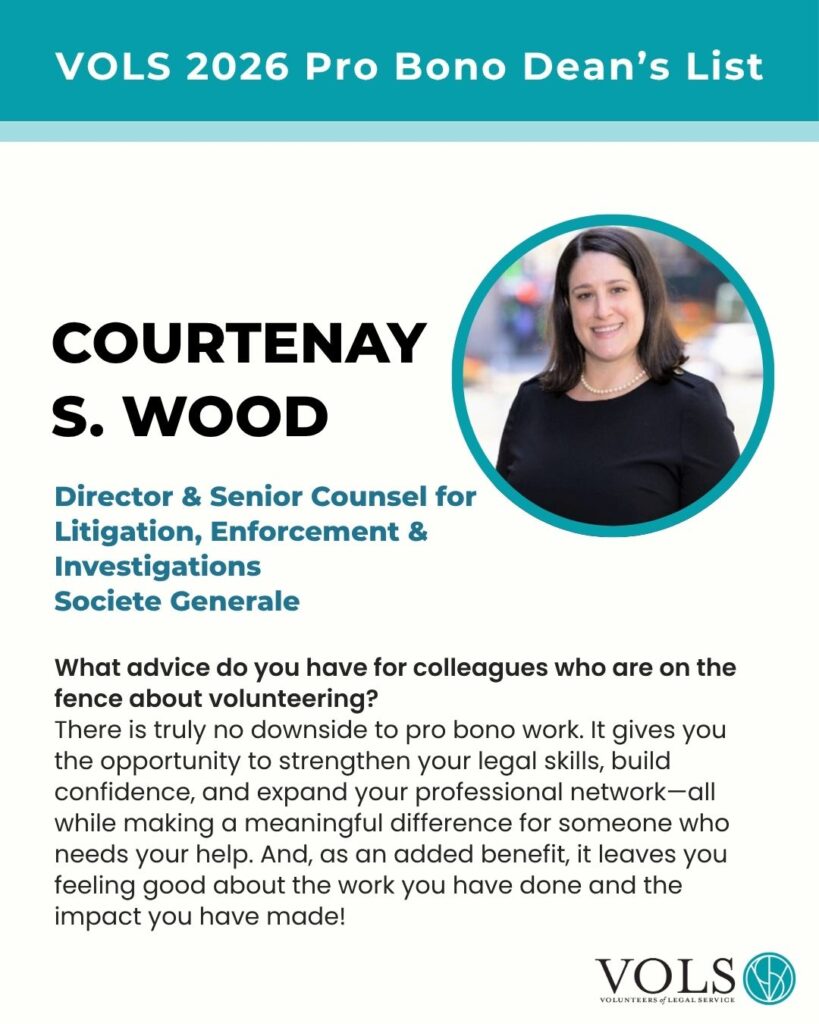
COURTENAY S. WOOD
Director & Senior Counsel for Litigation, Enforcement & Investigations
Societe Generale
How did you become involved with VOLS? What interested you in volunteering with this specific project?
I first became involved with VOLS through Societe Generale’s in-house Pro Bono Program, working with the Senior Law Project on a clinic where we helped clients draft wills, powers of attorney, and health care proxies. I really enjoyed working with the wonderful staff attorneys at VOLS and having the opportunity to use my legal skills to help older New Yorkers put essential planning documents in place and gain greater peace of mind. This experience led me to seek other opportunities to work with VOLS.
I have always been interested in working with emerging small businesses and the Microenterprise Project felt like a perfect fit. While studying at CUNY School of Law, I worked in the Community & Economic Development Clinic providing free legal support for grassroots community-based businesses and nonprofit organizations. Working with the Microenterprise Project has given me the opportunity to once again use the law creatively to combat structural inequalities in New York City and beyond.
How has pro bono work impacted your experience as an attorney?
Working with VOLS has been an incredibly rewarding and beneficial experience, both personally and professionally. VOLS staff are deeply committed to understanding the needs of the communities they serve and designing projects that have a major impact on the individual clients and beyond. Having the opportunity to work alongside such dedicated advocates has made me a better and more thoughtful lawyer in my own practice. The opportunities I’ve had working with VOLS have also allowed me to stay connected to the reason I chose to pursue the law in the first place.
Is there a pro bono moment and/or client that you found particularly memorable?
There are many, but perhaps the most poignant for me is a client I worked with during that first Senior Law Clinic in which we were helping clients draft wills, powers of attorney, and health care proxies. VOLS provided excellent support and training ahead of the event, but I was still a little nervous going in because I simply didn’t have experience discussing such personal topics in the context of providing legal advice.
That anxiety dissipated the moment we met our wonderful client. She greeted our entire team with hugs, told us how much not having these documents had weighed on her in recent years, and thanked us profusely for our help. What I’d feared would be a somewhat morbid conversation turned out to be one of the most joyful experiences of my legal career. The client was so excited and grateful to have the resources she needed to get her affairs in order that we spent as much of the day laughing and talking like old friends as we did drafting the documents. The relief she felt when the documents were executed was palpable and, of course, we ended the day with another hug!
Tell us about how you have worked with the VOLS’ legal team.
I have felt incredibly fortunate to work closely with VOLS’ legal team across multiple projects, as they are a dedicated and exceptional bunch! The training and support they’ve provided in connection with the smaller hands-on clinics has allowed me to take on projects that are outside of my comfort zone without sacrificing the level of service we’re providing to clients.
More recently, I’ve worked with the Microenterprise Project to host larger events where we invite entrepreneurs and small businesses owners to attend a series of presentations by industry experts covering essential topics like entity selection, employment law, fundraising, and marketing. VOLS’ deep ties within the community and understanding of the unique needs of small businesses have made these events incredibly popular and impactful.
What advice do you have for colleagues who are on the fence about volunteering?
There is truly no downside to pro bono work. It gives you the opportunity to strengthen your legal skills, build confidence, and expand your professional network—all while making a meaningful difference for someone who needs your help. And, as an added benefit, it leaves you feeling good about the work you have done and the impact you have made!